Your Catalog Is Your Asset, Most Labels Treat It Like an Archive
Ask a label owner what their company is worth, and most of them cannot answer without a long pause. The masters, the publishing shares, the contracts, the relationships, all of it adds up to something. But the thing that holds it together, the catalog itself, is usually scattered across so many places that nobody could value it in an afternoon if they had to.
This is the quiet problem at the centre of most independent labels. The catalog is the business. It is the asset on the balance sheet, the thing a buyer would pay for, the thing that keeps paying out for decades. And it is stored like a pile of old receipts: some in Dropbox, some in a Google Sheet, the splits in an email thread, the masters on a hard drive in a drawer, the contracts in a folder nobody has opened since the deal closed.
An archive is something you put away. An asset is something you work. The difference between the two is organisation, and most labels are on the wrong side of it without realising the cost.
The point where the spreadsheet stops working
Every label starts on a spreadsheet, and it works for longer than you would expect. One person, one tab per artist, columns for title, ISRC, release date, splits. For a while that is genuinely enough.
It stops working at a specific moment, and the moment is rarely about size. You can run a thirty-artist roster on a spreadsheet if you are disciplined and you are the only person touching it. What breaks the spreadsheet is the second person. The day your distribution partner, your new A&R hire, or the artist's manager needs to read or change the same data, the spreadsheet becomes a liability. Two people edit it, one overwrites the other, and now you have two versions and no way to know which is true.
The second thing that breaks it is the file problem. A spreadsheet can hold a row that says "final master, v3." It cannot hold the master. So the audio lives somewhere else, and the link between the row and the file is a human being remembering which Dropbox folder it is in. That link breaks constantly.
By the time you notice, you do not have a catalog. You have a spreadsheet that describes a catalog, sitting next to a pile of files that may or may not match it.
What a messy catalog actually costs
The costs are real, they are just spread thin enough that nobody adds them up.
Missed and delayed royalties. When splits live in an email and never get formalised, money shows up months later for a contributor whose share was never registered. The royalty arrives in a black-box pile and sits there. This is not rare. It is the default outcome of splits that were agreed in a chat and never written into anything official.
Deals that die on diligence. A sync supervisor wants a track for a campaign and needs the rights cleared by Friday. If clearing it means three days of "let me find who played bass on this" and "I think the publishing split was 60/40 but let me check," the supervisor moves on to a track they can clear today. You did not lose the deal on the music. You lost it on the paperwork.
Staff time spent on archaeology. Every label has someone whose week quietly fills up with "where is the latest version" and "which folder has the artwork." That is a salary being spent on hunting instead of signing, releasing, and growing.
A discount when you sell. A catalog a buyer cannot easily inspect is a catalog a buyer pays less for. The chaos is not just an operating annoyance. It is a haircut on the asset's value.
What buyers, supervisors, and distributors actually need
The fastest way to understand what a well-organised catalog looks like is to ask what the people who pull on it actually need. They all want the same three things.
They want it to be complete. Every track has its ISRC, its splits totalling 100%, its contributors with their real identifiers, its master clearly labelled as the final version. Not "mostly there." Complete.
They want it to be current. The version marked "final" is actually final. The split that is recorded is the split that was agreed. There is one source of truth, and it is right.
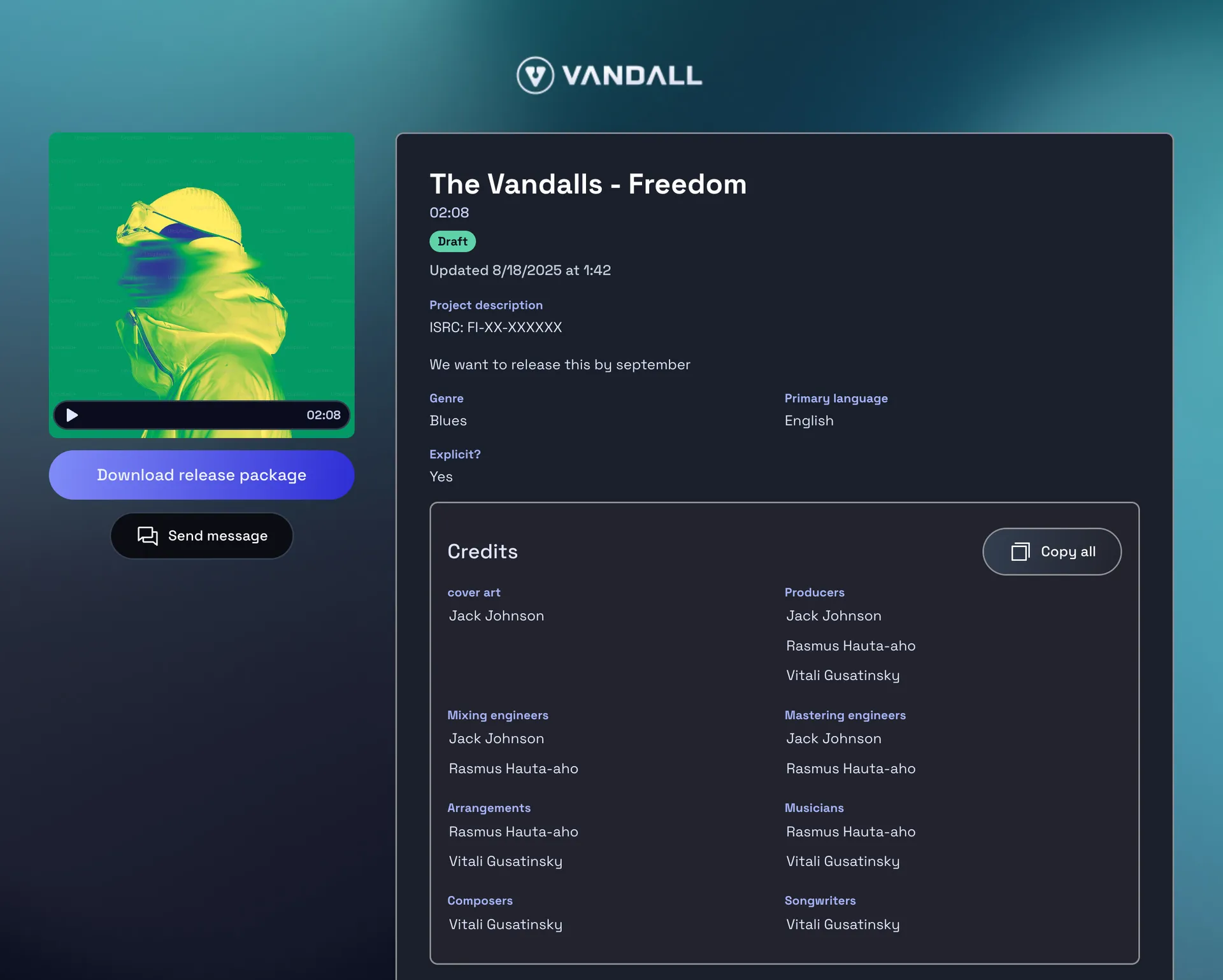
A release a buyer or distributor can open and read on their own: the track, the metadata, the full credits, nothing locked in your head.
A catalog that is complete, current, and self-serve is worth more than the same recordings stored in chaos. Same masters, same songs, different value, entirely because of how they are organised.
The five fields small labels get wrong
Metadata sounds boring until a payment routes to the wrong person. These are the fields that cause the most trouble when they are missing or wrong:
- ISRC. One per recording, assigned once, never reused. Labels routinely have tracks with no ISRC, or the same ISRC on two versions.
- Splits that total 100%. Not 95, not 103. The number of agreements that quietly do not add up is higher than anyone wants to admit, and it surfaces only when the money does.
- Contributor identifiers, IPI and IPN. A name is not enough to route a royalty. A producer credited as "Mike" does not get paid. The IPI number is what connects a credit to a payment.
- The canonical master. Which file is the one that was released? If three files are named "master_final," none of them is.
- Release date and status. Released, scheduled, or shelved. A catalog that cannot tell you what is actually out is a catalog you cannot report on.
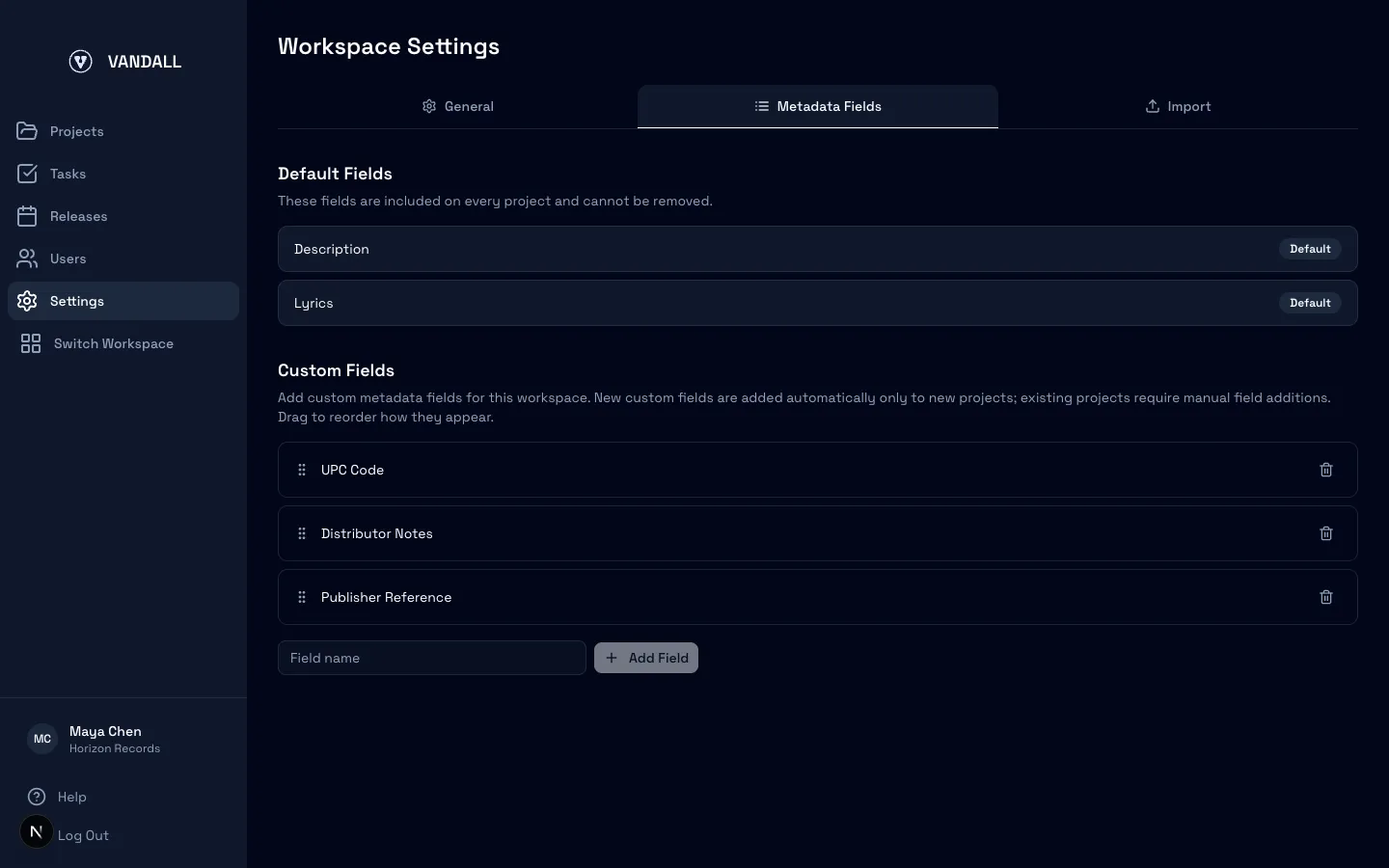
Set the fields your label tracks once, at the workspace level. Every new release inherits them, so nothing ships with a blank ISRC.
Files, versions, and splits belong in one place
The deepest version of the catalog problem is that the three things that define a release, the files, the versions, and the splits, almost always live in three different tools. The audio is in Dropbox. The version history is in someone's file-naming convention. The splits are in a Google Doc or a signed PDF in an inbox.
As long as those three things are separated, keeping them in sync is manual work, and manual work drifts. The split sheet says one contributor; the credits in the metadata say another. The "final" in the folder name and the "final" everyone is actually using are different files.
Consolidation is not about having one tool that does everything. It is about the catalog having a centre of gravity, one place where the audio, the metadata, the versions, the credits, and the splits sit together, on the same object, so they cannot drift apart. When the split sheet is attached to the track instead of floating in an inbox, it stops being a thing you have to remember and starts being a property of the recording itself.
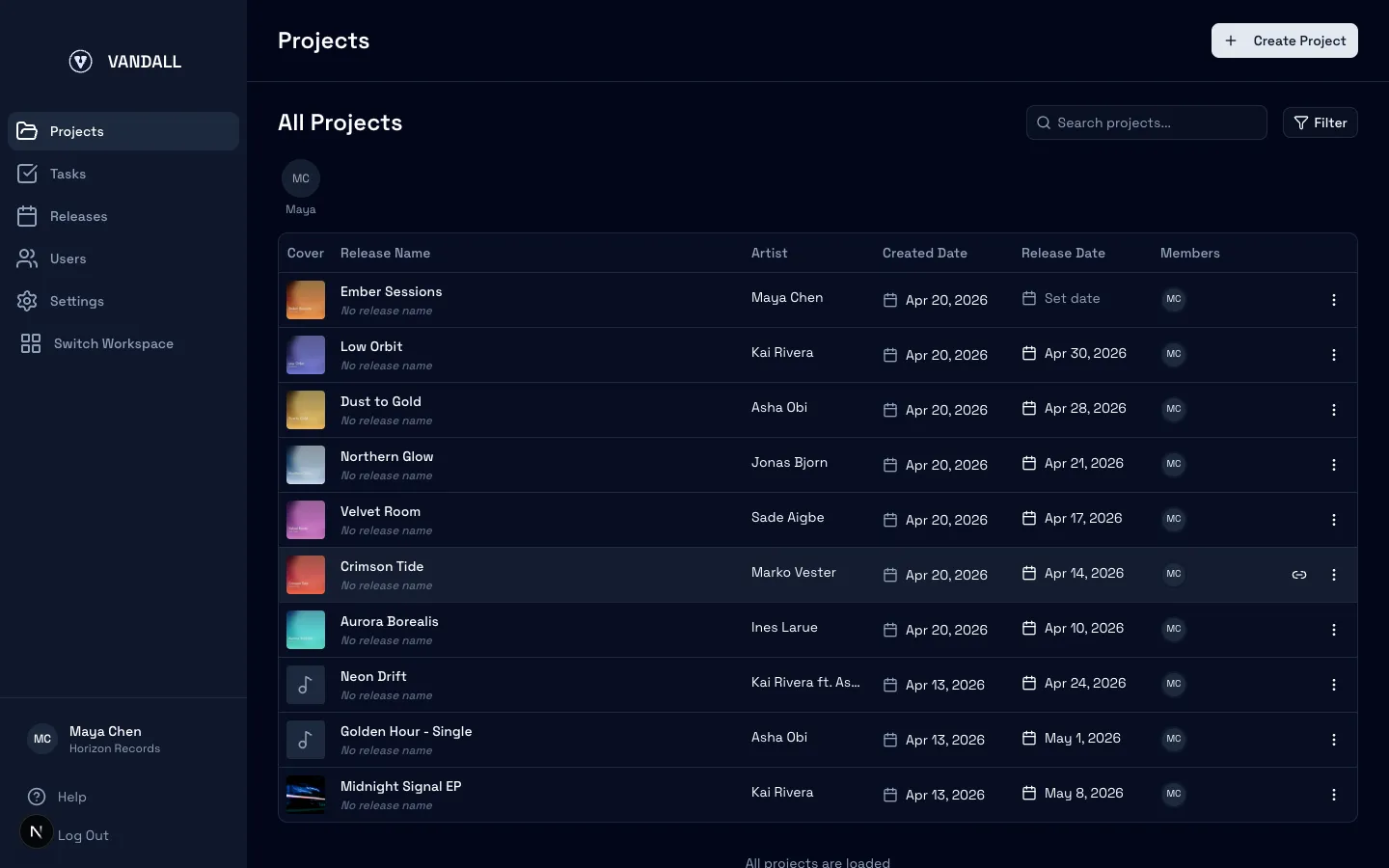
One catalog, one view. Every release with the columns you choose, sortable, filterable, and exportable to a spreadsheet in a click.
That is the whole shift from archive to asset: the catalog stops being a description of your work stored next to your work, and becomes the work itself, organised so anyone can pick it up.
How to audit your catalog this weekend
You do not need new software to find out where you stand. You need a couple of hours and an honest spreadsheet. For each release, mark yes or no on five things:
- Can you find the final master in under a minute?
- Does it have an ISRC?
- Do the splits exist in writing and total 100%?
- Are all contributors credited with identifiers, not just names?
- Could a distributor or buyer inspect this release without calling you?
Count the no's. That number is the gap between an archive and an asset, and it is almost always bigger than the owner expects. The point of the exercise is not to feel bad. It is that you cannot fix, or value, what you have not measured.
Once you can see the gap, closing it is a process: capture the missing fields, pick a canonical home, and stop letting new releases enter the catalog in the old scattered way. The legacy mess can finish where it lives. Just do not start the next release in four tools.
A label's catalog is the most valuable thing it owns and the most neglected. Treated as an archive, it slowly costs you royalties, deals, and resale value. Treated as an asset, organised, complete, and ready for anyone to inspect, it is the foundation everything else is built on.
The recordings are already yours. The only question is whether they are working for you or sitting in a drawer.
See how Vandall keeps a catalog in one place: files, metadata, versions, credits, and splits on every release, so your catalog reads like the asset it is. Explore Vandall Business.